Technology
It drives by sight.
FAMA navigates with vision alone — no GPS, no base stations, no signal dependency. Onboard cameras and intelligence turn what the machine sees into decisions, and decisions into physical action.
Why vision
Vision beats GPS where farming actually happens.
GPS-based autonomy depends on satellites, base stations, and correction services — infrastructure that fails exactly where farms live: under tree lines, in valleys, and far from reliable connectivity. FAMA takes a different path. It reads the field the way a skilled operator does: with its eyes.
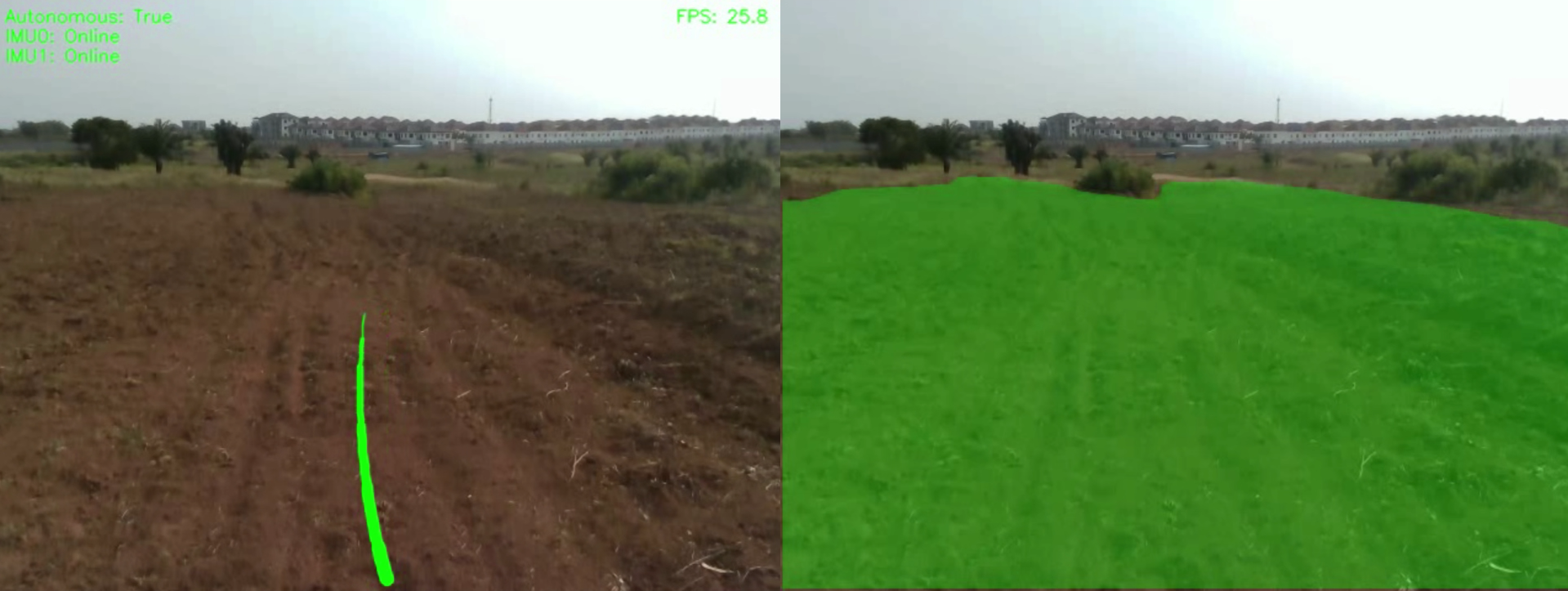
FAMA's vision stack — cameras and depth sensing build the field model that drives every decision.
- No infrastructure — No RTK base stations, no correction services, no signal relays. FAMA needs nothing but the field itself.
- Reads the crop, not just coordinates — Vision sees rows, plants, and obstacles directly — the information that actually matters for farming, not abstract map coordinates.
- Works anywhere — No signal loss under canopy, clouds, or in valleys. The same machine runs identically on any farm on earth.
- Lower cost to deploy — GPS autonomy carries a hardware and services tax most farms cannot absorb. Vision keeps the intelligence onboard — and affordable.
The perception-to-action stack
Perceive. Localize. Plan. Control. Act.
Perception — Cameras + depth
Multi-spectral and RGB cameras with stereo depth give FAMA a live understanding of its surroundings — the way an experienced operator reads a field.
Localization — Vision-based spatial understanding
Onboard SLAM helps FAMA understand where it is as it works. No GPS. No signal dependency. No external infrastructure.
Planning — Field-aware path planning
Path planning adapts to field geometry, crop spacing, and unexpected conditions as they emerge — replanning in real time.
Control — Vehicle-level control
Executes planned paths with centimeter-level precision across uneven terrain — steering forward, sideways, or in place.
Intelligence — Edge inference
All perception and decision-making runs onboard. The robot operates fully autonomously, even with zero connectivity.
Embodiment — Actuation + robot hardware
A modular implement system translates decisions into physical action: seeding, weeding, spot spraying, and fertilizing.
Data loop
Every field makes it smarter
Every field, season, and deployment generates new edge cases. They flow back into the models and the machine, making the system smarter with every acre. Five years of that loop is the foundation everything else is built on.